Nicole Domres' first job at Pennsylvania-based Miller Fabrication Solutions was cleaning up after everyone else's shift. Nobody hands you a production schedule for four global OEM customers on day one; rather, that took eight years, a move into receiving, two promotions into crew leadership and the slow accumulation of skills nobody teaches in a classroom: how to read a forklift's limits, how a warehouse actually breathes, how a floor really runs versus how the org chart says it runs. In 2021, MetalForming magazine recognized what that persistence had built, naming her a Woman of Excellence in Metal Forming and Fabricating.
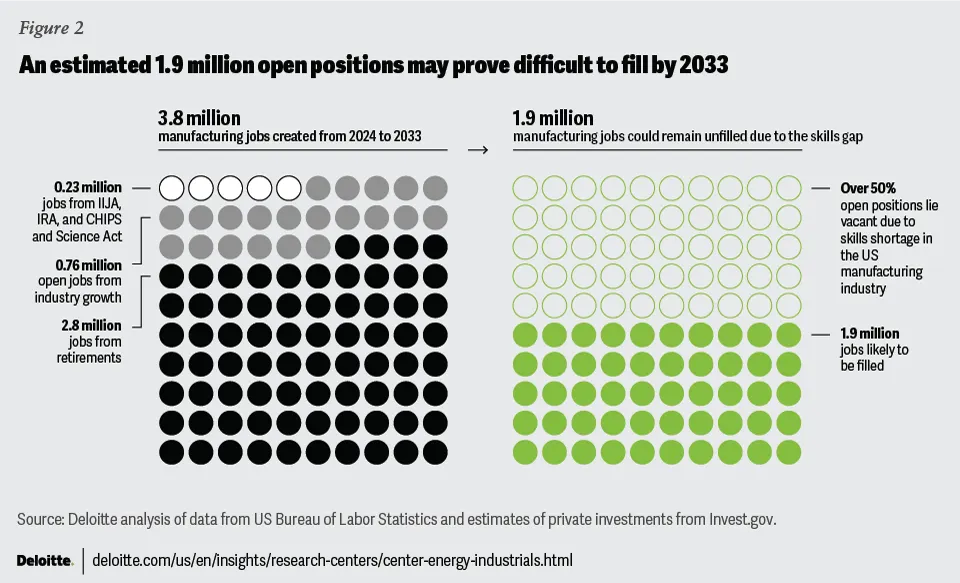
It's the kind of story that makes you want to know what happened next for this star employee - and manufacturers tend to have more of them than they realize. They'll need to start prioritizing them, particularly as Deloitte and the Manufacturing Institute project U.S. manufacturers could need up to 3.8 million additional workers between 2024 and 2033, with as many as 1.9 million of those roles potentially going unfilled. The skilled labor shortage isn't a new issue, yet sixty-five percent of manufacturers surveyed in that same research still name talent attraction and retention as their top business challenge.
Manufacturing (MFG) Day, to be held on October 2 this year, offers a platform to make good use of these types of stories. The event brings students, educators and parents inside plants to see what modern manufacturing actually looks like, often with access to hands-on activities, job fairs and Q&A discussions with experts in fields like engineering, technology or operations. An initiative of the Manufacturing Institute, MFG Day is intentionally framed as more than a single day, giving organizers room to carry the momentum behind the brand into the weeks and months ahead.

From open house to strategy, and from strategy to proof
Creating a memorable experience for prospective candidates well past the first Friday of October takes a talent marketing strategy, not just a good tour and branded hats (though they help!). That means leadership, marketing and talent/HR teams coming together before the event to identify the business objective and target audiences, validate the employee value proposition and brand messaging and build out the candidate pipeline.
But a strategy is only as good as the evidence it produces, and this is where many MFG Day recaps stop short: they report on the day itself in terms of headcount, photos and a locally-run news clip, as if the tour were the outcome rather than the starting point. The more useful question a strategy should be built to answer is what happens in the weeks and months after the busloads of students go home.
Evolve MFG Day around outcomes, not just activity
That proof doesn't have to come from attendance alone. Treated as the first touchpoint in a longer funnel, MFG Day can be measured the way any other talent or demand-generation investment would be - through what it converts into downstream, not just what it draws in the door.
- Reach. How many people actually walked the floor versus how many said they would? Attendance is the easiest number to report and the least revealing on its own, but if tracked against RSVPs and broken out by student groups, parents, educators and local officials, it starts to show which outreach channels and workforce development and school partnerships are worth repeating next year.
- Engagement. Not everyone who shows up is paying attention. Tour completion, time spent at hands-on stations and questions asked during Q&A sessions say more about impact than a check-in sheet does. A short exit survey, even just five questions on a tablet at the door, can turn a one-day event into a dataset.
- Conversion. This is the pivot point where MFG Day stops being a PR exercise and starts being a recruiting one: applications submitted, apprenticeship or co-op sign-ups and interviews scheduled in the two to four weeks following the event. Tagging MFG Day as a source in your Applicant Tracking System (ATS) can be a critical factor in understanding its recruitment power.
- Outcome. Hires attributed to the event should be tracked at 90 and 180 days out rather than 30. Manufacturing hiring cycles, especially for students still finishing a program, rarely close in a month, and a scorecard that only looks 30 days back will undercount the very outcomes it's trying to prove.
- Perception. This is the metric most companies skip, and often it’s the most persuasive internally. By using a pre-and post-event perception survey asking attendees, particularly students and parents, ask how their view of a manufacturing career (as well as your company, specifically) shifted. Awareness and image movement don't show up in an ATS, but they're frequently what convinces a 17-year-old to apply to a technical program two years later.
Stories as a proof point
This is where employee stories like Nicole Domres' do more than inspire, they become proof points inside the funnel itself. A story shared at a MFG Day event or in the weeks after isn't just a feel-good addition to the tour; it's content that can be tracked. Did it get shared on social channels tagged to the event? Did it drive traffic to a careers page in the days following? Did an attendee reference it in an interview six months later, or in an exit survey as the reason they applied? Stories are often the most remarkable part of the day and treating them as measurable content, and not just morale-building, closes the loop between "we told a great story" and "the story did something."
Manufacturers don't lack the raw material for this kind of proof, but they do often lack a habit of tracking and reporting it properly. Reframing MFG Day as the top of a funnel, with a target and an actual at each stage from reach through hires, turns a single October event into a talent marketing program with a return leadership can actually see. Towers Fractional Marketing works with manufacturers and industrial companies to build exactly that kind of strategy: aligning marketing, HR and leadership around a shared talent pipeline, and setting up the measurement to prove what's working. If your MFG Day plans need that connective layer, let's talk.