A new CRO joins the organization, with marketing falling under his Go-To-Market (GTM) domain. Like many new executives, he’s questioning everything: “Are we running enough campaigns, or too little?” “Are we running the right campaigns?” “How much is marketing truly impacting sales pipeline?”
No one seems to know the answer.
Not because nothing has happened. Content marketing is publishing a healthy number of assets. Demand generation is concurrently running 20+ unique campaigns. Marketing operations is enabling on-time and accurate campaign deliveries. But the connection is not wholly visible - that is, cleanly, credibly - to revenue. And in that silence, roles are scrutinized, budgets are under fire and an entire team appears as an overhead line item.

This CRO is not the only one to experience this exercise, and certainly won’t be the last. According to the 2025 Gartner CMO Spend Survey, 59% of CMOs report they lack sufficient budget to execute their strategy. And yet marketing budgets have flatlined at 7.7% of overall company revenue for the second year running. When marketing can't prove its value, growth stalls. And according to a study by Viant, 36% of CFOs cite CMOs' reliance on vanity metrics, like when Microsoft was reporting on Xbox console shipment numbers instead of the more indicative monthly active users number, as a top concern. This reinforces the perception of marketing as a cost center, placing it on the chopping block as soon as sales go soft – or a new executive enters the business.
The problem isn't necessarily the marketing team itself, but its accountability architecture. Small-to-medium sized (SMB) manufacturers, SaaS and MSP/IT services businesses typically don’t (or can’t) spend the time or effort to build the structure that ties each person's work to business outcomes over time. In that absence, here are three frameworks - not “magic bullets” - that can help improve that.
1. The Role-Based KPI Scorecard
The most common mistake in marketing measurement isn't measuring too little. It's measuring everything and understanding nothing. Compound this issue with the fact that leadership is under pressure to see quarterly movement and may not stay patient while waiting for the longer-term effects of marketing to take hold, as one Harvard Business School senior lecturer noted in HBR.
A role-based KPI scorecard helps to solve this by assigning each team member three to five metrics specific to their function and traceable to revenue impact. Content marketing, for example, can own the number of assets published, downloads and a percentage of content-influenced pipeline. Demand gen can own e-mail performance, AEO/SEO and brand indicators. Marketing ops can own campaign QC/QA, team eNPS and marketing budget performance.
Each quarter, these scorecards sit alongside actual revenue outcomes, factoring in sales cycle lengths and marketing impact lags. Over time, the data should tell a real story about which contributions are sparking new business opportunities, which assets are shortening sales conversations and where effort and investment simply aren't moving the needle. Most importantly, it’s about the team converging on successful outcomes.
2. The OKR Framework
BCG research confirms that the OKR framework has emerged as a go-to methodology for significantly improving organizational performance - and marketing is no exception. Sitting above all the usual KPIs, this framework leans on 3–5 marketing Objectives directly tied to company outcomes, like expanding revenue within targeted professional services microverticals within two years. Each Objective gets 3–4 outcome‑style Key Results (e.g., “Attract 100 new MQLs from each targeted microvertical each quarter”) and every campaign or initiative must clearly connect to at least one of those KRs.
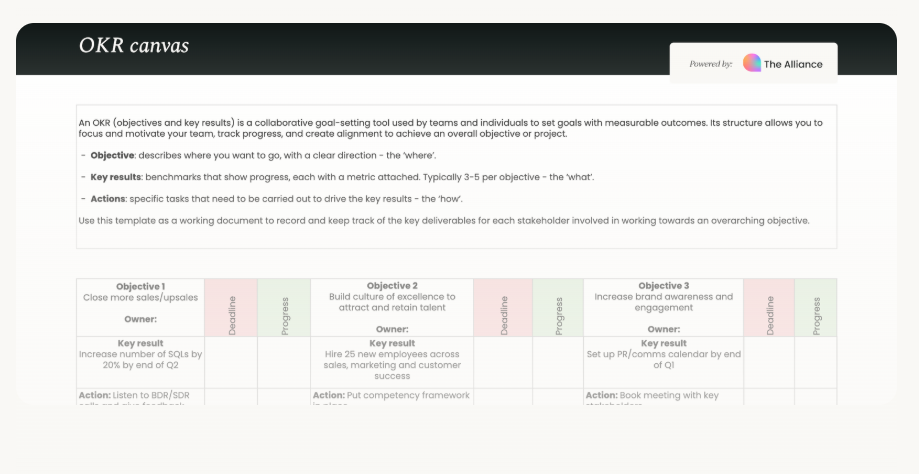
Teams should be organized into pods that own Objectives, not just channels, such as demand gen (net‑new pipeline), customer & partner (adoption and expansion) and marketing ops (data, tech, reporting). Weekly pod meetings start with, “How are we tracking on our KRs?” and only then dive into KPIs as diagnostics: if pipeline is behind, you check conversion rates, landing page performance, offer fit and channel mix to see what to change.
Quarterly, each pod also scores itself on capabilities, including strategy, execution, learning and collaboration, and sets 1–2 improvement moves (for example, “shorten creative cycle time by 20%” or “run 10 structured A/B tests”). Over a few cycles, the culture shifts: people propose work in terms of which Objective and KR it supports, and the team can tell a crisp story to leadership about effectiveness that blends outcomes (OKRs), supporting evidence (KPIs) and capability improvement.
3. Contribution Modeling
This model complements KPIs and OKRs by tying marketing to specific revenue levers to answer a simple question: “When marketing shows up, how do win rate, deal size, cycle time and retention change?” In practice, each revenue lever is assigned a clear hypothesis and owner, for example: “Win rate in segment X increases from 24% to 30% with targeted programs.”
Each lever gets a clear owner or pod, plus an explicit “how:”
- Win rate and deal quality → owned by a demand gen pod lead plus their sales counterpart
- Sales cycle length → owned by the same pod plus marketing ops
- ACV and expansion → owned by customer/partner marketing
- Retention → owned by customer marketing and customer success

Teams define contribution KRs tied to each lever (e.g., faster deal velocity or higher win rates in engaged accounts), with individual roles aligned to delivery:
Campaigns → coverage and engagement
Content → assets that support key buying moments
Ops → data integrity and reporting
Accountability then focuses on whether a marketer’s work moved their lever in the right direction, in the accounts they were supposed to influence. Keep in mind, you’re not trying to perfectly allocate credit for each touch, but verify how each team-owned cohort moved their respective revenue lever.
Strategically Focused. Tactically Actioned.
No single framework wins for every team, every industry or every growth stage. The most effective B2B companies blend elements of all three: role-based clarity, OKR-driven alignment and contribution-based accountability. Your team is probably utilizing at least one model today; it then becomes an exercise in standardization with team buy-in and iterating with intention.
If your marketing team is producing good work but struggling to prove its revenue impact, particularly in light of a looming liquidity event- a fractional marketing leader, like Towers Fractional Marketing, can accelerate that process significantly. With an outside perspective, deep industry and business expertise and flexible engagement options, Towers can help you build the accountability architecture your team deserves.
Ready to tie your marketing output to real revenue outcomes? Contact Towers Fractional Marketing to start the conversation.